

A scope that will not bend is one of the most common faults in a repair workshop, and one of the most frequently misdiagnosed. The angulation system is a chain of mechanical components — wires, pulleys, mesh, rubber — and the symptom rarely points to the component that actually failed. This walkthrough takes the fault from symptom to cause.
How Angulation Actually Works
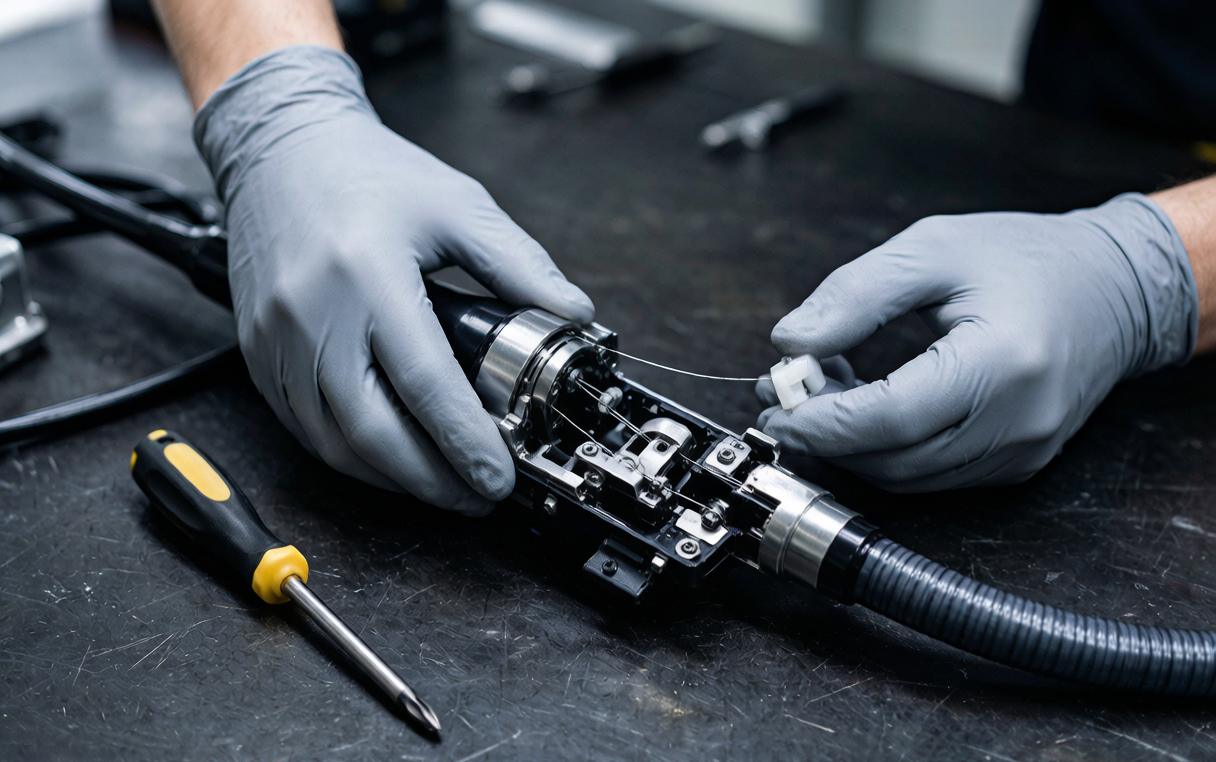
Angulation wires are the core transmission components that let the operator steer a flexible endoscope. Rotating the angulation knobs on the control body tensions or releases the wires, driving the distal bending section to bend in one or more directions. The connection between the two ends is entirely mechanical: there is no servo, no sensor, and no feedback loop. Whatever the knob does, the wire transmits — and nothing else.
Three properties make the system work:
- Angulation control. Knob rotation tensions or releases the control wires, driving the distal bending section.
- Precise positioning and stability. Balanced tension among the wires lets the distal tip hold an angle once positioned, which is what makes observation and instrument manipulation possible.
- Force transmission. The wires carry mechanical input from the control body to the distal section, and the quality of that transmission determines whether angulation feels responsive or vague.
MEDWALT supplies endoscope angulation wires and the angulation pulley assembly as separate components — which matters, because they fail differently.
What the Pulley Assembly Does
Pulleys are the reason the system can transmit force over a curved path without destroying the wires. Their functions are specific:
- Change the direction of force on the traction wires. The pulley acts as a guiding and redirecting structure, transmitting force from the control section along the designed path to the distal bending portion.
- Enable efficient force transmission. Rolling or semi-rolling contact converts knob movement into stable, controllable wire tension.
- Reduce friction and stress concentration. Compared with routing a wire directly around a fixed structure, a pulley significantly lowers wire-to-metal friction — reducing the risk of fatigue and breakage.
- Ensure bending accuracy and consistency. Balanced tension distribution across the up/down and left/right directions produces symmetrical, repeatable bending angles.
- Enhance system durability. By minimizing wire wear and metal abrasion, the pulley assembly is a key component for long-term reliability.
The Dual-Rail Pulley configuration is one of the arrangements used to guide multiple wires along defined paths within the control section. When ordering replacement pulleys, specify the configuration and the scope model — a pulley that guides the wire path incorrectly produces angulation that feels almost right, which is worse than a fault that fails outright.
Diagnostic Walkthrough: Symptom to Cause
Start from what the technician observes at the tip, then work back. The table below maps the common presentations to the components that most often produce them.
| Symptom at the tip | First check | Likely cause | Part to inspect or replace |
|---|---|---|---|
| No bending in one direction | Knob travel and wire tension at the control body | Wire broken or detached from the chain | Angulation wire |
| Bending feels rough or gritty | Wire path through the control section | Pulley wear or wire riding a damaged surface | Pulley assembly |
| Tip will not hold an angle | Tension balance across all four wires | Uneven tension; one wire stretched or slack | Wire set; rebalance at the chain |
| Angulation reduced in all directions | Bending section for stiffness or deformation | Distal section damage, mesh or rubber constraint | Bending mesh; bending section |
| Knob turns but tip barely moves | Wire continuity from knob to bending section | Wire stretched; linkage slipping | Wire; control section linkage |
| Asymmetric angle left versus right | Pulley routing and wire paths | Incorrect pulley configuration or assembly error | Pulley assembly |
The step technicians skip
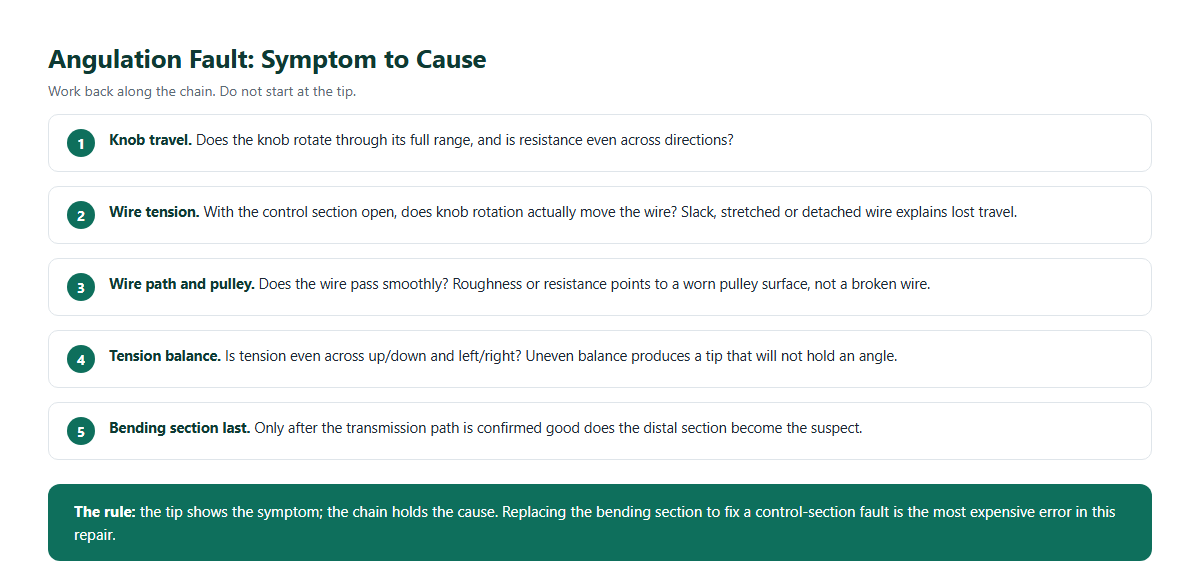
Most misdiagnosis happens because the fault is chased from the distal end. A scope that will not bend is often assumed to have a damaged bending section, and the bending section is then replaced — an expensive component — without confirming that the wire still transmits force.
Check the transmission path first. With the control section open, verify that knob rotation actually moves the wire and that tension is balanced across directions. If the wire moves freely and tension is even, the fault is distal. If the wire is slack, stretched, or broken, or if the path through the pulleys is worn, the fault is in the control section — and replacing the bending section would not have fixed it.
Diagnose the chain, not the tip. The tip shows the symptom; the chain holds the cause.
Prevention: What Actually Extends Angulation Life
- Never force the knobs. Resistance is information — forcing past it converts a wire problem into a wire break and often takes the pulley surface with it.
- Lock the angulation during storage and transport. Uncontrolled tip movement loads the wires at every handling step.
- Watch for the roughness stage. The gritty feeling that precedes failure comes from wire-on-metal friction. Catching it at the pulley stage is a component repair; catching it after breakage is a teardown.
- Replace as a set where tension balance matters. A single new wire against three aged ones rarely restores symmetrical angulation.
- Keep the bending section clean and undamaged. A deformed mesh or hardened rubber fights the wires and accelerates wear upstream.
Frequently Asked Questions
Can a single angulation wire be replaced on its own?
Physically yes, but tension balance is the reason to be careful. Angulation quality depends on even tension across the wire set, so a single new wire against aged counterparts often restores function without restoring symmetry. Assess the other wires at the same time.
How do I tell a wire fault from a pulley fault?
By feel and by path. Wire faults present as lost travel or a direction that does not respond. Pulley faults present as roughness or resistance as the wire passes through the control section, because the wire is riding a worn surface.
What does Dual-Rail Pulley mean?
It refers to a pulley arrangement that guides wire along two defined rails within the control section. When ordering, specify the configuration along with the scope model, since incorrect routing produces angulation that is subtly wrong rather than obviously broken.
Is reduced angulation always a repair?
Not always. Some reduction is normal with age and accumulated wear. The decision point is whether function has degraded enough to affect procedure performance or whether the resistance signals an active fault that will progress to breakage.
Conclusion
Angulation faults are mechanical and therefore diagnosable — provided the diagnostic route follows the chain rather than the symptom. Tension first, then routing and pulley condition, then the bending section. Following that order prevents the most common and most expensive error in endoscope repair: replacing a distal assembly to fix a control-section fault.
MEDWALT supplies angulation wires, pulley assemblies, bending mesh, and related components across the angulation range and control section range. Contact us with your scope models for part numbers and specifications.
Tracing an angulation fault? Send us the scope model for a parts list →
<!– ==========
