

Two of the least expensive items in an endoscopy unit — a silicone waterproof cover and a disposable biopsy cap — protect the two most expensive assemblies in a flexible endoscope. Skip them, and the repair invoice arrives in four figures. This guide explains what each part does, how failures actually start, and how to set a replacement rhythm that costs almost nothing.
Two Parts, One Job: Keeping Fluid Where It Belongs
A flexible endoscope is a sealed optical and electronic instrument that is expected to survive immersion, repeated disinfection, and hundreds of working cycles. Its internal assemblies — the light guide bundle, the flexible board, the charge-coupled device or CMOS stack in the distal tip — cannot be dried out or replaced cheaply once contaminated.
Everything that keeps them dry comes down to two small consumables at opposite ends of the scope:
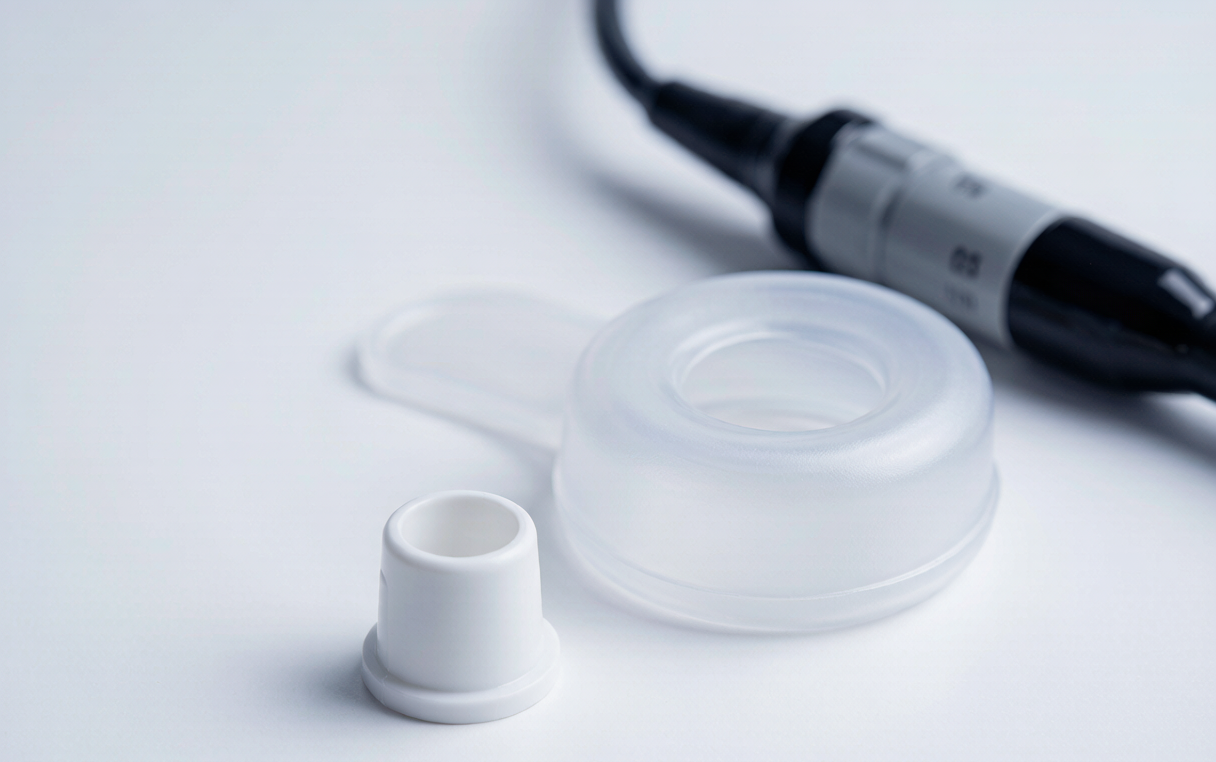
- The waterproof cover seals the control section’s electrical interfaces during immersion and leakage testing.
- The biopsy cap closes the working channel port on the control body between insertions, preventing fluid ingress while still allowing instruments through.
Both are the kind of part that gets ordered in bags, not units. Both are also the first thing technicians find missing when a scope arrives with fluid inside.
What Each Part Actually Protects
Waterproof cover: the immersion seal
The waterproof cover protects the electrical and video interfaces on the control section during the periods when the scope is not connected to its processor — most critically during manual cleaning and leakage testing. Scopes that are submerged without a cover, or with a cover that has hardened, split, or stretched past a snug fit, allow fluid to reach the control section interior and the umbilical connector.
MEDWALT supplies OEM-compatible waterproof covers for Olympus endoscopes. Because cover geometry differs between scope generations, confirm the model when ordering rather than assuming one size fits a family.
Biopsy cap: the working channel gate
The biopsy cap sits on the instrument channel port. It has two jobs that pull in opposite directions: seal when nothing is inserted, and open cleanly when a biopsy forceps, snare, or cytology brush passes through. A cap that no longer seals admits fluid with every insertion. A cap that grips too tightly tears or drags instruments.
MEDWALT biopsy caps are compatible with Olympus, Pentax, and Fujinon platforms — see biopsy caps and the wider biopsy channel and caps range.
Why These Failures Are So Expensive
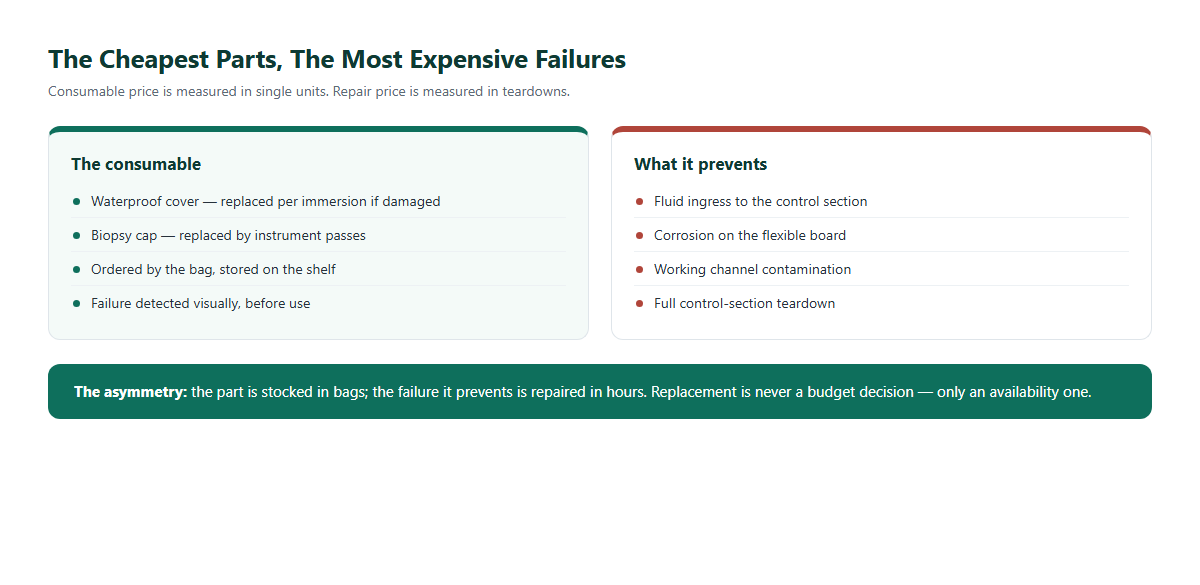
The parts cost a fraction of what they protect. The failure path is short and predictable.
| Failure | What happens next | Where the cost lands |
|---|---|---|
| Waterproof cover missing or split during immersion | Fluid reaches the control section and umbilical interfaces | Control section teardown; corrosion and electrical faults on the flexible board |
| Biopsy cap no longer seals | Small volumes of fluid and debris enter the working channel on each instrument pass | Channel contamination, cleaning failures, premature channel replacement |
| Cover reused far past its service life | Elastomer hardens, loses the compression that creates the seal | Intermittent leaks that pass testing one day and fail the next |
| Cap left off between procedures | Port remains open during handling and transport | Fluid ingress found only during the next leak test |
The pattern is consistent: a consumable that costs almost nothing to replace becomes the entry point for damage that costs everything to repair. This is the same mechanism behind most leak test failures — the test detects the result, not the cause.
How to Set a Replacement Rhythm
Neither part fails on a fixed schedule — they fail on a usage schedule. Build the rhythm from how the scope is actually used, not from the calendar.
- Treat the biopsy cap as a per-case consumable. Replacement frequency should follow instrument passes, not days. High-volume units that reuse caps across many procedures are trading a negligible saving against channel damage.
- Inspect the waterproof cover at every immersion. Check for splits, hardening, and loss of elasticity. A cover that has lost its grip on the interface is not sealing, regardless of how intact it looks.
- Stock both as bulk consumables. Availability is the real failure mode in most units — a missing cover at 7 a.m. becomes a scope submerged without one. Keep enough on the shelf that replacement is never a decision.
- Confirm compatibility by model. Cap and cover geometry varies across platforms and generations. Order against the scope model, not the brand alone.
- Log replacements next to leak test results. When a leak test fails, the log tells you whether the consumable was fresh or overdue — and turns an expensive mystery into a cheap fix.
Buy the consumables by the bag, replace them by the case, and the most expensive repairs in the workshop simply stop appearing.
A Note on Compatibility and Sourcing
These are low-cost parts, which makes them a common target for unbranded, unspecified stock. The distinction that matters is documentation: a cap or cover that arrives with a stated compatible model and material specification can be verified against the scope in front of you. One that arrives with neither cannot. For the general sourcing framework, see sourcing OEM-compatible endoscope parts.
Frequently Asked Questions
How often should a biopsy cap be replaced?
Base the interval on instrument passes rather than elapsed time. In high-throughput units many facilities treat the cap as a single-case item; lower-volume settings extend it. If the cap no longer seals with nothing inserted, it is past due regardless of the schedule.
Can a waterproof cover be reused?
Reuse is common but finite. The elastomer loses compression with each cycle, and a cover that no longer grips is not sealing. Inspect for splits and hardening before every immersion and discard on any doubt.
Are these parts compatible across Olympus, Pentax, and Fujinon?
Not universally. Biopsy cap compatibility spans the three major platforms, while waterproof cover geometry is tied to specific scope generations. Order against the exact model.
What if a scope was immersed without a cover?
Stop using it and treat it as a suspected fluid-ingress event: perform leak testing and a full function check before returning it to service. Damage from a single immersion can be limited if it is caught immediately, and expensive if it is not.
Conclusion
The waterproof cover and the biopsy cap are the two parts most likely to be treated as an afterthought, and the two most likely to be implicated when a scope arrives with fluid inside. They cost almost nothing to keep in stock and almost everything to skip. Units that manage them as scheduled consumables — inspected every immersion, replaced by usage, stocked in bulk — remove an entire category of repair from their annual budget.
MEDWALT supplies waterproof covers, biopsy caps, and the broader peripheral accessories range for flexible endoscope repair. Contact us with your scope models for compatible part numbers, material specifications, and a quote.
Need consumables matched to your scope models? Request a quote from MEDWALT →
