

Every channel in a flexible endoscope is cleaned and inspected. The water bottle is not a channel, and that is exactly why it gets missed. This guide traces the air and water delivery path from bottle to distal nozzle, and shows where cleaning attention usually stops short.
The Path Nobody Draws
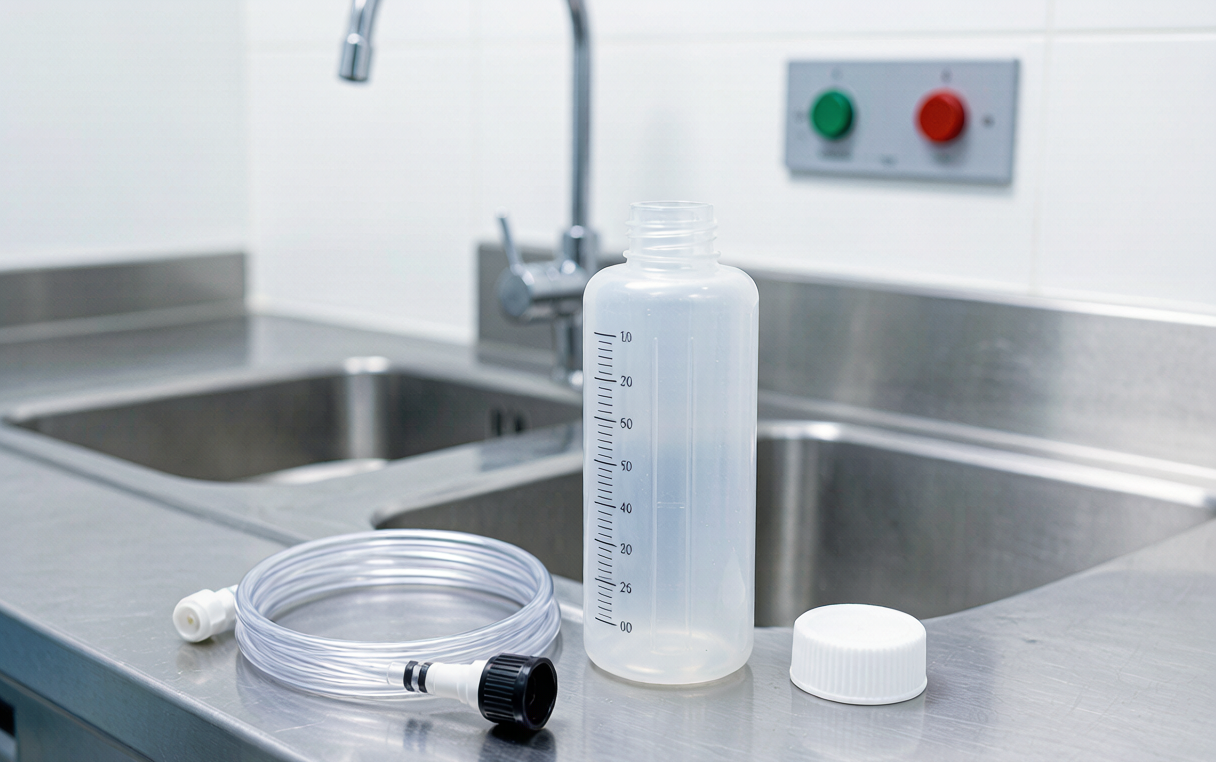
Ask a reprocessing team to list the channels they clean and they will name the biopsy channel, the suction channel, the air and water channels. All correct. Now ask about the water bottle, its cap, its tubing, and the connector on the control body — the path that carries fluid into the scope before any of those channels see it.
The air and water system is a single delivery path with several components in series:
- The water bottle holds the irrigation fluid and pressurizes it for delivery.
- The bottle cap and tubing carry that fluid to the control body.
- The air/water channel runs the length of the insertion tube.
- The air/water nozzle sits at the distal tip as the terminal component.
Every one of these is a wet, warm, dark environment. Every one of them is a potential site for residue accumulation. And the one furthest from the procedure — the bottle on its stand — is the one least likely to appear on a cleaning checklist.
What the Channel and the Nozzle Actually Do
Air/water channel
The air/water channel is a critical functional lumen in a flexible endoscope, used to deliver air or CO₂ and water to the distal end to support visualization and clinical operation. It performs three distinct jobs:
- Air insufflation. In gastrointestinal endoscopy the channel delivers air or CO₂ into the tract to achieve controlled lumen distension and mucosal fold expansion — improving visualization and procedural conditions.
- Water irrigation. Water is delivered to the distal nozzle to rinse mucus, blood, or tissue debris from the objective lens, keeping imaging clear and stable.
- Air/water control. Delivery is switched between air and water by the air/water valve on the control body.
Because the channel is required to be flexible, biocompatible, and resistant to repeated chemical exposure, it is one of the components most sensitive to both mechanical and chemical wear. MEDWALT supplies air/water channels as replacement components.
Air/water nozzle
The nozzle sits at the distal end as the terminal component of the water and air channel. It directs water and air toward the objective lens to clean the lens and maintain visualization, and delivers gas into the lumen to improve viewing conditions. Two parameters govern its performance: orifice size and spray angle, which together determine spray direction, flow stability, and cleaning efficiency.
The nozzle is typically made from materials with good biocompatibility and resistance to disinfection — medical-grade stainless steel such as SUS304 or SUS316, and medical-grade engineering plastics such as PEEK or PPS. Its design and material selection have a direct effect on image quality and device reliability. See air/water nozzles.
Where Contamination Accumulates
The failure mode is not dramatic. It builds up.
| Component | What accumulates | Observable consequence | Action |
|---|---|---|---|
| Water bottle and cap | Residue from irrigation fluid; biofilm on interior surfaces | Cloudy fluid delivered to the lens; reduced cleaning effect | Full disassembly and cleaning at the interval set by your facility protocol |
| Bottle tubing and connector | Residue at connection points and inside the lumen | Reduced flow; inconsistent spray | Inspect for cracks and residue; replace when flow is measurably reduced |
| Air/water channel | Debris and chemical residue along the lumen | Weakening spray; uneven delivery | Cleaning per channel protocol; replace when irrigation no longer restores function |
| Air/water nozzle | Mineral and protein deposits at the orifice | Distorted spray pattern; visible deposits blocking the port | Inspect at the distal tip during every check; replace on any blockage or distortion |
| Air/water valve | Residue at the sealing surfaces | Sticking valve; failure to switch between air and water | Clean and inspect per protocol; replace on stiffness or leakage |
Why the nozzle is the diagnostic tell
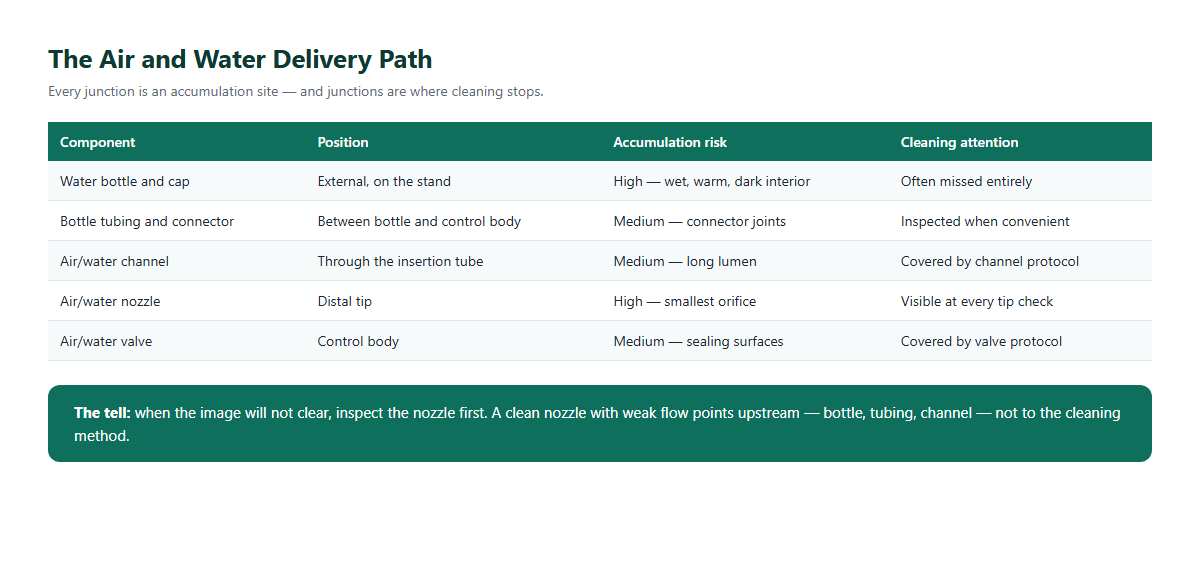
The distal nozzle is the end of the line. When irrigation becomes weak or the spray pattern distorts, the nozzle tells you whether the problem is distal or upstream: a clean nozzle with weak flow points upstream to the bottle, tubing, or channel. A blocked or distorted nozzle is the problem itself. Inspect the nozzle first — it is the easiest component to see and the cheapest to replace.
Building a Check Rhythm
- Put the bottle on the reprocessing checklist. If it is not written down, it is not being done. The bottle and cap are reusable components on the fluid path and belong in the same protocol logic as any channel.
- Inspect the nozzle at every distal-tip check. Look for deposits, distortion, and flow pattern. This is a visual check that takes seconds and catches the fault at its cheapest stage.
- Flush and verify flow, not just presence. A channel that accepts fluid is not necessarily delivering it. Confirm spray behavior at the tip rather than assuming from the connection end.
- Replace tubing on condition, not on schedule. Cracks and hardened connectors leak before they fail visibly. Inspect at every disassembly.
- Track image clarity complaints as a signal. Repeated “the lens will not clear” reports from users are usually a delivery-path problem, not a cleaning-effort problem.
The lens is only as clean as the path feeding it. When the image will not clear, check the delivery path before repeating the cleaning step.
A Note on Reprocessing Protocols
Cleaning intervals, disinfection methods, and validation requirements are defined by your facility’s reprocessing protocol and by the instructions supplied with each device. This article describes the components on the delivery path and their observable failure modes; it does not prescribe reprocessing procedure. Consult the applicable protocol and manufacturer instructions for the devices in your unit.
For the testing side of the same system, see our guide to leak testing and to air/water valve failures.
Frequently Asked Questions
Is the water bottle reusable?
The bottle and cap are reusable components and are supplied as replacement parts for that purpose. Follow your facility’s reprocessing protocol for cleaning intervals and methods.
How do I know when to replace the air/water nozzle?
Replace on any visible blockage, distortion of the spray pattern, or deposits at the orifice that cleaning does not remove. The nozzle is inexpensive relative to the components upstream of it.
Weak irrigation: nozzle or channel?
Inspect the nozzle first. If it is clean and unobstructed but flow remains weak, the restriction is upstream — in the bottle, tubing, connector, or channel.
What materials are used for the nozzle?
Medical-grade stainless steel such as SUS304 or SUS316, and medical-grade engineering plastics such as PEEK or PPS, selected for biocompatibility and resistance to disinfection.
Conclusion
The air and water delivery path is short, largely reusable, and only partially visible during routine reprocessing — which is precisely why it gets overlooked. The components on it are inexpensive and the symptoms they produce are subtle until they are not. Adding the bottle, tubing, and nozzle to the existing cleaning and inspection rhythm closes a gap that most units do not know they have.
MEDWALT supplies water bottles, air/water channels, air/water nozzles, and related items across the air/water component range. Contact us with your scope models for part numbers and specifications.
Rebuilding the air and water path? Request a component list from MEDWALT →
