

When an image goes dark, the first suspect is usually the light source or the processor. Both are expensive to replace and both are frequently innocent. The light guide bundle — tens of thousands of optical fibers running the length of the scope — degrades quietly, and it can be measured before it costs you a procedure. This guide covers what the bundle is, how it fails, and how to assess output loss.
What a Light Guide Bundle Is
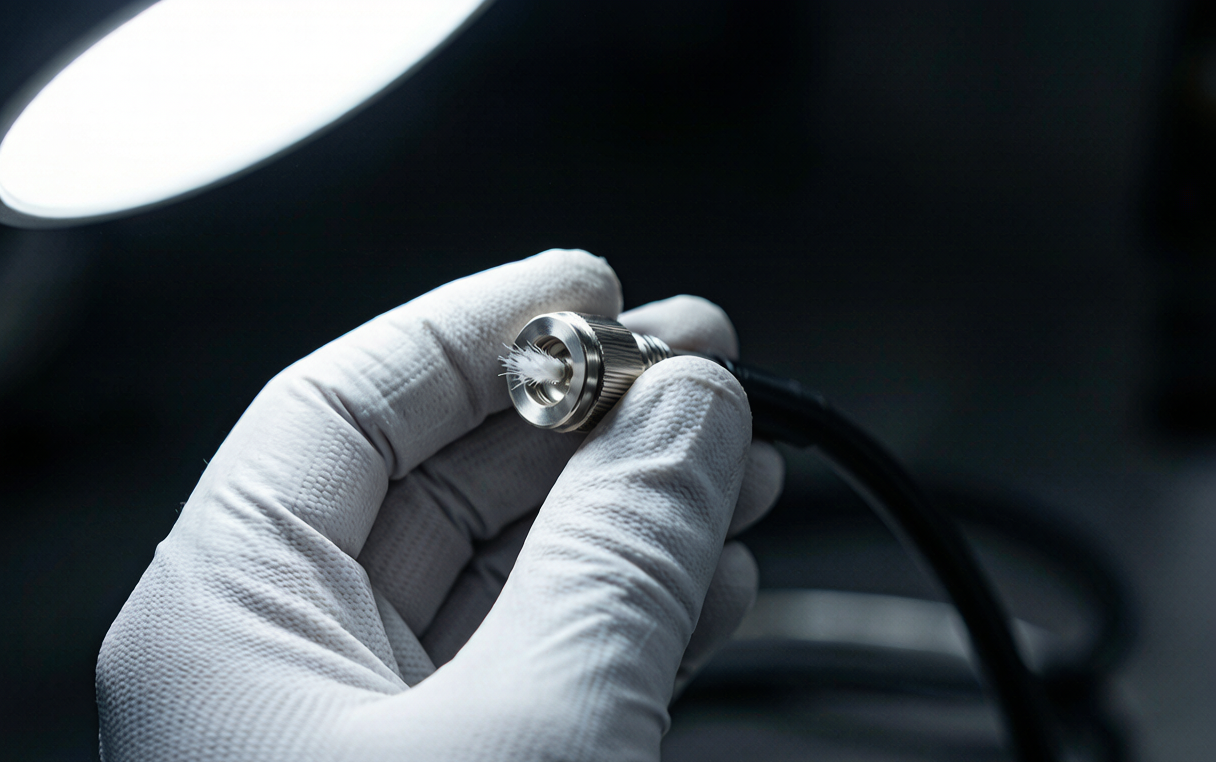
A light guide bundle is composed of tens of thousands to hundreds of thousands of optical fiber filaments. Individual filaments are tens of micrometers in diameter — roughly half the thickness of a human hair. At that scale, even glass bends freely.
Light normally passes straight through glass. An optical fiber instead captures and guides light along its length, the way a hose guides water. The mechanism is a dual structure of two materials with different refractive indices: light undergoes countless internal reflections and emerges at the far end. Nothing is amplified and nothing is generated — the bundle only carries what the light source provides, minus what the path loses.
Bundle features in current supply include:
- Material: Schott® optical glass fiber, selected for high light transmittance and transparency.
- Protective sleeve: ultra-thin flexible sleeve, available in white or black.
- Divergence angle: 80° or 120°, depending on the application.
- Configuration: one-to-two and one-to-three options available on request.
- Typical applications: gastroscope, colonoscope, bronchoscope and related flexible platforms.
MEDWALT supplies light guide bundles and the light guide tube that carries the bundle through the umbilical section.
How Bundles Degrade
Light output falls for mechanical reasons, not optical mystery. Four mechanisms account for most loss:
| Mechanism | How it happens | Effect on output | How it presents |
|---|---|---|---|
| Fiber fracture | Repeated flexing, kinking or crushing of the umbilical section | Progressive loss proportional to the number of broken fibers | Gradual dimming; visible dark speckle at the connector face |
| End-face contamination | Residue, scratches or deposits at the connector face | Immediate reduction; can be severe | Sudden dimming after reprocessing or handling |
| Thermal and chemical aging | Repeated sterilization cycles affecting the sleeve and fiber cladding | Slow cumulative loss across the bundle | Output drifting downward over months |
| Sleeve damage | Wear or splitting of the protective sleeve | Localized loss plus risk of further fiber damage | Visible sleeve damage during inspection; output loss at specific angles |
Only the second mechanism is reversible. Fractured fiber and aged cladding do not heal, which is why the distinction between the four matters before any part is ordered.
Assessing Output Loss
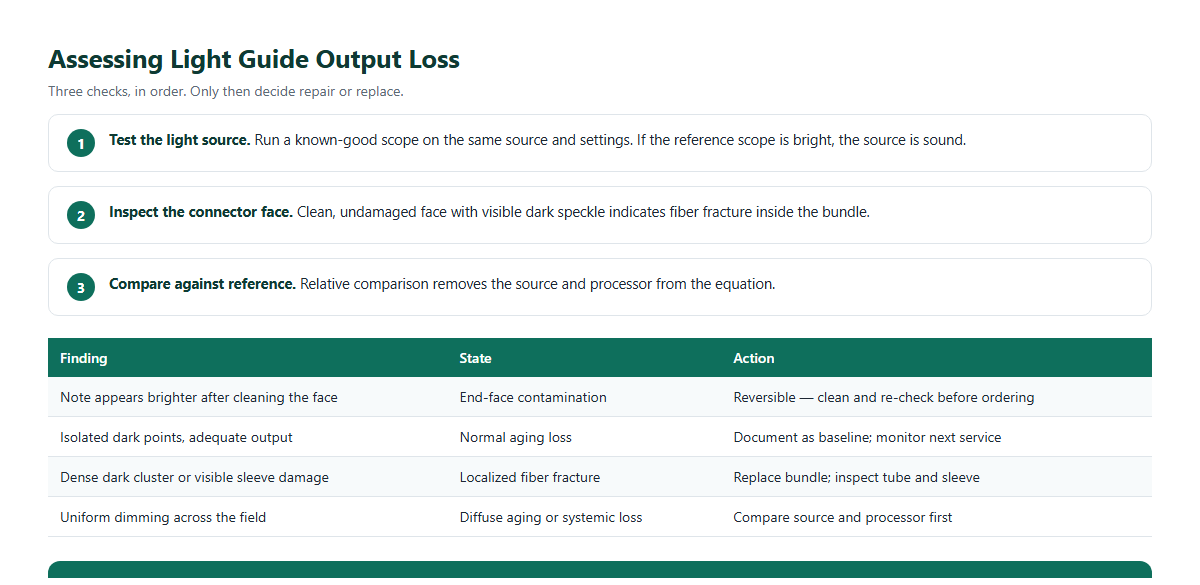
Step 1: Separate the three suspects
Dim imaging has three possible origins — light source, bundle, or imaging chain. Isolate them before ordering anything:
- Check the light source on a known-good scope. If the reference scope is bright, the source is delivering.
- Inspect the connector face. A clean, undamaged face with visible dark speckle indicates fiber fracture within the bundle.
- Compare against a reference scope on the same source and settings. Relative comparison removes the light source from the equation entirely.
For the imaging side of the same question, see CMOS versus CCD sensors in flexible endoscopes and 4K and 8K resolution in flexible endoscopy.
Step 2: Look at the connector face
The connector face is the cheapest and fastest diagnostic available. Individual broken fibers appear as dark points against the lit fiber field. A scattering of dark points is normal in a well-used bundle; a dense cluster indicates localized damage, usually from handling at that specific section.
Step 3: Decide repair or replace
| Observation | Likely state | Usual action |
|---|---|---|
| Clean face, note appears brighter | End-face contamination | Clean the connector face and re-check output before any replacement |
| Isolated dark points, adequate output on reference comparison | Normal aging loss | Document as a baseline; monitor at the next service interval |
| Dense dark cluster or visible sleeve damage | Localized fiber fracture | Replace the bundle; inspect the surrounding tube and sleeve |
| Uniform dimming across the field | Diffuse aging or systemic loss | Compare against the light source and processor before deciding |
A note on numbers
Acceptable transmission thresholds differ between scope platforms, bundle configurations, and the measurement method used. Treat any specific percentage as platform-specific and confirm the applicable value for your model rather than adopting a single figure across a mixed fleet.
Protecting What You Have
- Respect the bend radius of the umbilical section. Fiber fracture is mechanical and accumulates from handling, not from procedure use alone.
- Protect the connector face. Cap it during transport and storage; contamination at the face is the one failure mode that is fully reversible.
- Inspect the sleeve at every major service. Sleeve damage precedes fiber damage in many cases.
- Record output reference readings. Without a baseline, every dimming event looks urgent. With one, you can tell drift from an acute fault.
- Match the configuration when replacing. Divergence angle and one-to-two or one-to-three configuration affect how the delivered light behaves at the distal end.
A bundle does not fail suddenly. It loses fibers one at a time — which means the fault is measurable long before it becomes a procedure problem.
Frequently Asked Questions
Can a light guide bundle be repaired, or must it be replaced?
Fractured fibers cannot be re-joined in the field. Replacement is the usual route; cleaning the connector face addresses the reversible subset of output loss.
What divergence angle do I need?
Both 80° and 120° configurations are available, and the choice depends on the application and the illumination profile the scope is designed for. Specify the application when ordering.
How can I tell bundle loss from a weak light source?
Test the light source against a known-good scope. If the reference scope is bright, the source is sound and the loss is in the bundle or the imaging chain.
Is some dark speckle at the connector normal?
Yes. A well-used bundle accumulates isolated fiber fractures over time. The concern is a dense cluster, visible sleeve damage, or output that falls below the level your platform requires for adequate illumination.
Conclusion
Light guide bundles degrade in a way that is easy to measure and easy to ignore until the image itself becomes the problem. Because loss accumulates fiber by fiber, units that check the light source, inspect the connector face, and compare against a reference scope can order a replacement as planned maintenance instead of an emergency — and avoid replacing a light source that was never the fault.
MEDWALT supplies light guide bundles, light guide tubes, and related components across the light bundles and lens range. Contact us with your scope models for configurations, divergence angles, and specifications.
Replacing a degraded bundle? Send us your scope model for the correct configuration →
